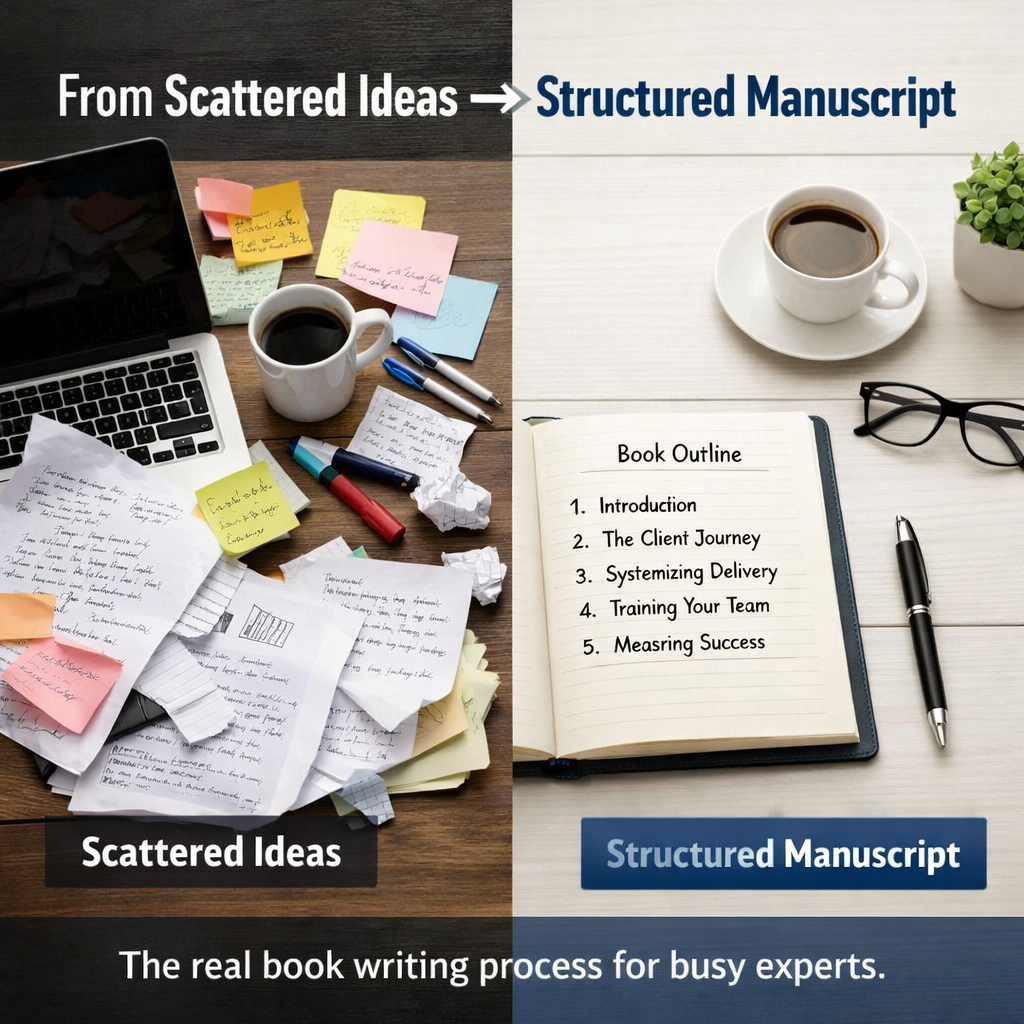
If you’ve ever thought, “I know I have a book in me, but I don’t know how to get it out,” this case study is for you.
Because most first-time business authors do not struggle with a lack of expertise.
They struggle with:
- too many ideas
- no clear structure
- inconsistent writing time
- perfectionism
- and the very real challenge of building a manuscript while still running a business
In other words: they’re not blocked because they’re unqualified. They’re blocked because they’re busy.
This is a realistic case study of what the book writing process can look like for a coach/consultant-type expert moving from scattered ideas to a usable draft. It illustrates how topic clarity, structure, accountability, and professional manuscript development support can turn “I should write a book someday” into a real manuscript.
(For privacy, this is a composite case study based on common patterns seen in expert authors, not a single named client.)
If you’ve been wondering whether writing a business book is actually feasible—or whether you should get help writing a book—this will help you see the path more clearly.
And yes, there are some messy middle moments. That’s where the good stuff lives.
The Starting Point: Strong Expertise, No Manuscript
Meet the Author (Composite Profile)
Let’s call her Melissa.
Melissa is an experienced consultant and coach who helps service-based business owners improve client retention and streamline delivery. She has years of results, a strong reputation, and a process she uses repeatedly with clients.
On paper, she looks like the ideal person to write a book.
She has:
- a proven framework
- client stories and outcomes
- speaking experience
- workshop content
- strong opinions (always helpful in a book)
- a business that would benefit from greater authority and visibility
What she did not have was a manuscript.
What she did have:
- 47 notes in Google Docs
- old workshop slides
- two half-written chapter attempts
- voice memos recorded in the car
- a lot of “I know what I want to say, I just can’t get it organized”
Sound familiar? This is incredibly common.
Many experts are not starting from zero. They’re starting from a pile.
That pile is not failure. It’s raw material.
The Real Problem Wasn’t Writing Skill
When Melissa first described her challenge, she said, “I’m not sure I’m a good enough writer.”
That was understandable—but it wasn’t accurate.
She was a strong communicator. She could explain her ideas clearly to clients. She could train teams. She could teach workshops. She could answer questions with clarity and confidence.
The real issues were:
1) No clear book position
She had multiple possible topics:
- client retention
- operations
- leadership
- team communication
- onboarding systems
All relevant. None yet narrowed into one clear book promise.
2) No reader definition
She was trying to write for:
- all service businesses
- founders
- managers
- coaches
- consultants
- “anyone who wants to improve operations”
That’s a wide net. Wide nets catch vague chapters.
3) No chapter roadmap
She was writing wherever inspiration struck, which meant progress felt random and hard to measure.
4) No writing rhythm
She was trying to “fit it in” around client work, which usually meant it got pushed to the end of the day—when her brain had already clocked out.
5) Perfectionism in early drafts
She edited every paragraph while drafting, which made each section feel painfully slow.
This is why the book writing process matters so much. Without one, even highly capable people can feel stuck for a long time.
Phase 1: Clarifying the Book Idea and Business Purpose
Before writing more chapters, the first step was not “write harder.”
It was clarity.
This is where book writing coaching services are often most valuable: helping the author choose the right book before they spend months writing the wrong one.
Step 1: Define the purpose of the book
Melissa originally said, “I just want to get my ideas out there.”
Fair. But that’s not a strategy.
Through a guided process, she clarified that the book needed to do three things:
- Build authority in her niche
- Help prospects understand her framework faster
- Support speaking opportunities and consultations
That shift changed everything.
Now the book was not just a general “business book.” It was a strategic asset.
This is one of the biggest lessons in learning how to write a book for business:
A book works better when it has a job.
Step 2: Narrow the audience
Instead of writing for “all business owners,” she narrowed the primary reader to:
Service-based business owners with small teams who are losing clients due to inconsistent delivery and communication gaps.
Now the content had direction.
Step 3: Clarify the transformation
We defined the before/after:
- Before: Client experience feels inconsistent; retention is lower than it should be; delivery is too dependent on the owner.
- After: The owner has a repeatable client delivery process that improves retention and reduces chaos.
That became the core promise of the book.
And suddenly, chapter ideas started getting easier.
Imagine that—clarity works.
Phase 2: Building the Book Structure Before Drafting
Melissa’s first instinct was to start writing chapters immediately. Instead, we paused and built structure.
This felt slower for about a week and saved a lot of rewriting later.
Creating the chapter roadmap
We used her existing consulting process and client FAQs to build a chapter map.
Instead of “What should chapter 3 be called?” we used:
- What are the common stages clients go through?
- What mistakes happen repeatedly?
- What sequence creates results?
- What does the reader need to understand first?
That produced a clean chapter progression:
- Why client retention problems are often delivery problems
- The hidden gaps in service experience
- Mapping the client journey
- Standardizing communication without sounding robotic
- Building repeatable delivery systems
- Training a team to deliver consistently
- Tracking and improving retention indicators
- Leading through process change
- Keeping the system human and adaptable
- Next steps for implementation
Why this mattered
Before the outline, every writing session began with uncertainty:
“What should I write today?”
After the outline, the question became:
“Which section of the plan am I drafting today?”
That’s a huge difference.
This is one of the most practical expert book writing tips for busy professionals:
Reduce decision-making before drafting.
The more decisions you make in advance, the easier it is to write when time is limited.
Phase 3: Content Capture Using What Already Existed
At this point, Melissa still believed she needed to “create” the entire book from scratch.
She didn’t.
A major breakthrough came from building a content inventory.
What she already had
We pulled material from:
- workshop slide decks
- client onboarding docs
- webinar trainings
- podcast guest appearances
- consulting notes (sanitized/generalized)
- email newsletters
- speaking outlines
- voice memos
Once mapped to chapters, she realized she had content for roughly 60–70% of the manuscript in raw form.
That changed her mindset from:
“I have to write a whole book.”
to:
“I need to organize, expand, and shape what I already know.”
That mental shift reduced overwhelm immediately.
The “teach-first” method
Melissa was much faster speaking than typing, so we used a talk-first process for several chapters:
- Record a focused audio teaching the chapter concept
- Transcribe it
- Pull out key points and examples
- Draft from the transcript
This preserved her natural voice and sped up drafting significantly.
For many experts, this is the bridge between “I can explain it” and “I can write it.”
And it’s one of the reasons people seek Inspired Press writing coaching—to use a process that matches how they naturally communicate, instead of forcing a one-size-fits-all writing method.
Phase 4: Creating a Realistic Writing Rhythm
This is where many projects live or die.
Melissa initially wanted to draft the book in six weeks.
Ambitious. Also unrealistic given her client load.
Instead of pushing a fantasy timeline, we built a schedule that worked with her actual life.
The writing plan we used
Weekly rhythm (12-week draft phase):
- 2 short sessions (25–35 minutes) for outlining/capture
- 1 longer session (90 minutes) for drafting
- 1 accountability check-in (progress review + next steps)
This plan was not glamorous. It was workable.
The rule that saved momentum
She used one simple rule:
“No editing while drafting.”
Not “no thinking.” Not “no fixing ever.” Just no line-editing in drafting sessions.
That prevented the common trap where one hour produces three polished paragraphs and zero meaningful progress.
What happened in practice
Some weeks she hit all sessions.
Some weeks she missed one.
A few weeks were messy because client demands spiked.
But because the process was structured, she could recover quickly without feeling like the whole project had collapsed.
That’s the real goal of a sustainable process:
not perfection—recoverability.
Phase 5: The Messy Middle (Where Most Authors Think They’re Failing)
Around the midpoint, Melissa hit what nearly every author hits:
- she felt repetitive
- she questioned the structure
- she became convinced the entire book was “too obvious”
- she started comparing herself to authors with very different books and audiences
This phase is normal. It is not proof the project is bad.
In fact, this is often the exact moment people start searching “get help writing a book” because the emotional resistance spikes just as the manuscript begins to take shape.
What helped her move through it
1) Re-centering on the reader
We revisited the target audience and book promise:
This book was not supposed to impress everyone.
It was supposed to help a specific reader solve a specific problem.
That narrowed the focus and reduced the “I need to say everything” pressure.
2) Section-level progress tracking
Instead of measuring progress by full chapters, we tracked:
- sections drafted
- examples collected
- chapter skeletons completed
- revision notes resolved
That made progress visible again.
3) “Good enough for draft” standards
She adopted a drafting standard:
- Clear > polished
- Useful > clever
- Complete > perfect
That standard helped her keep moving.
This is another reason book writing coaching services are valuable:
sometimes the biggest obstacle is not skill—it’s perspective.
A structured outside view can keep a temporary slump from turning into a long-term stall.
Phase 6: From Draft Fragments to a Full Rough Manuscript
By the end of the drafting phase, Melissa had:
- 10 chapter drafts in varying stages
- a strong working introduction (written later, as expected)
- examples and stories mapped into chapters
- a clearer articulation of her framework than she’d ever had before
Was it polished? No.
Was it complete enough to revise strategically? Absolutely.
And that is a major milestone many first-time authors underestimate.
A rough draft is not “almost published.”
But it is the moment the project becomes real.
What changed for her before the book was even finished
This is the part many experts don’t expect:
the benefits started before publication.
Because the manuscript required her to clarify her ideas, Melissa gained:
- better messaging in sales calls
- stronger workshop content
- cleaner explanations of her process
- more confidence in speaking about her methodology
This is one of the hidden benefits of learning how to write a book for business:
the writing process itself improves your business communication.
The book helps you sharpen the tool while you’re building it.
Phase 7: Professional Manuscript Development to Strengthen the Reader Experience
Once the rough draft was done, the next challenge was not “write more.”
It was “make this easier to read and use.”
This is where professional manuscript development became the right next step.
What the manuscript development review found
The draft had strong ideas and useful content, but also some common first-draft issues:
- repeated concepts in multiple chapters
- examples that were strong but too long
- a few chapters that overlapped in purpose
- uneven transitions between sections
- inconsistent action steps at the ends of chapters
None of this meant the draft was bad.
It meant the draft was a draft.
What development support improved
The development process focused on:
- tightening chapter boundaries
- improving flow and sequencing
- reducing repetition
- strengthening the reader journey
- standardizing chapter endings with practical action steps
- preserving Melissa’s voice while improving readability
This is the difference between having expertise on the page and having a manuscript that truly serves the reader.
And it’s why professional manuscript development is often a smart investment after drafting—especially for experts who are too close to the material to edit objectively.
Results: What This Process Produced
Let’s talk outcomes.
Tangible outcome
Melissa moved from “scattered ideas and false starts” to a complete rough draft ready for refinement.
That alone was a major win, but the bigger value was how she got there:
through a repeatable, sustainable book writing process built for a busy professional.
Strategic outcomes (before publication)
Even before final production, she was able to:
- clarify her core framework in marketing messaging
- improve consultations by explaining her process more clearly
- pull content from draft chapters for workshops and email content
- speak more confidently about her niche expertise
Psychological outcome (also important)
She stopped seeing “write a book” as a vague someday goal and started seeing herself as someone actively building a serious asset.
That shift matters.
A lot of experts stay stuck because the project feels too large and undefined. Once the process is visible, momentum becomes possible.
Key Lessons for Busy Experts Considering a Book
If you’re reading this and wondering whether this could work for you, here are the biggest takeaways from the case study.
1) You probably do not need more ideas
You likely need:
- clearer positioning
- stronger structure
- a simpler process
2) Start with purpose, not pages
If the book is meant to support your business, define its job first.
3) Use what you already have
Your talks, workshops, FAQs, and notes may already contain much of your raw material.
4) Build a writing rhythm for your real life
The best writing schedule is the one you can repeat.
5) Expect a messy middle
Doubt is part of the process, not evidence that you should quit.
6) Support can save months
Whether through book writing coaching services or professional manuscript development, the right support can reduce overwhelm and improve completion.
This is where Inspired Press writing coaching can make a meaningful difference: helping experts create a book that is not only finished, but strategically useful and true to their voice.
Final Thoughts: From “Someday” to Draft Is a Real Transformation
If you’ve been waiting until you feel fully ready, fully organized, or fully confident before starting your book, this case study is your reminder:
Most experts do not begin that way.
They begin with:
- expertise
- a few scattered notes
- a strong desire to help
- and a lot of uncertainty about the process
What changes the outcome is not superhuman discipline.
It’s structure.
A clear book writing process—plus the right level of support—can move you from idea to draft without burning out your schedule or your confidence.
If you’re ready to get help writing a book, Inspired Press writing coaching offers a practical path for busy experts who want to turn experience into a strategic manuscript. Whether you need guidance through the early stages, help maintaining momentum, or professional manuscript development to strengthen your draft, you do not have to figure it all out alone.
Your expertise is already valuable.
The right process helps you put it on the page.